
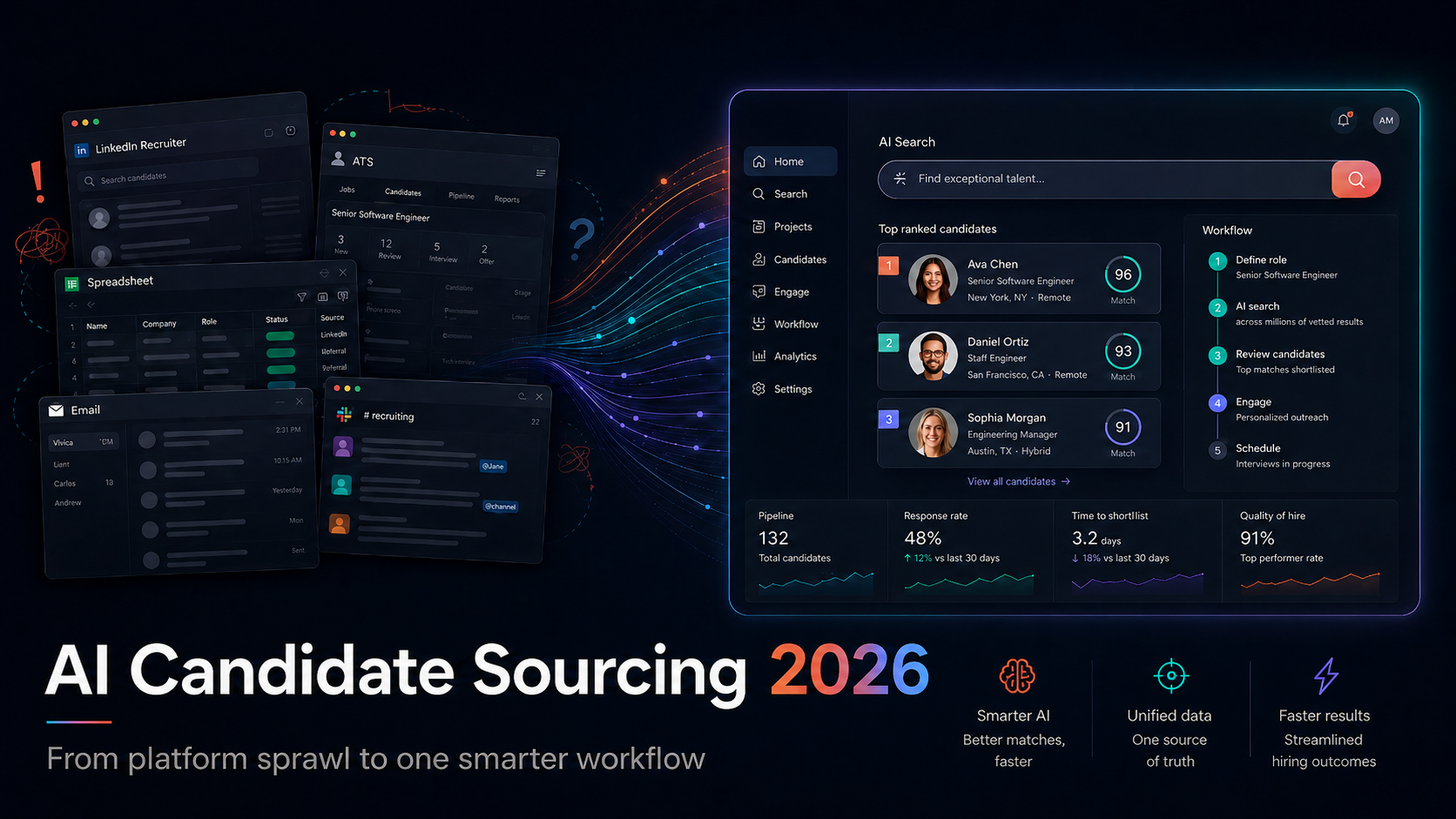
AI candidate sourcing 2026 is supposed to make recruiting faster, cleaner, and more precise. But for many teams, the daily workflow still starts with LinkedIn Recruiter, Indeed, the ATS, last week’s spreadsheet, Slack, and email open at the same time.
A recruiter opens LinkedIn Recruiter. Then Indeed. Then the ATS. Then a spreadsheet from last week. Then Slack, because someone might have replied overnight. Then email, because the hiring manager may have changed the role again.
Six tabs are open before one useful message has been sent.
This is not a dramatic example. This is a normal Tuesday for many recruiting teams in 2026. The strange part is that most of these teams already use modern tools. Some use AI screening. Some use sourcing platforms. Some use outreach automation. Some have dashboards that look impressive in quarterly meetings. And yet the daily work still feels scattered.
That is the real problem with AI candidate sourcing in 2026. The technology got faster. The workflow often did not get cleaner.
AI did not remove recruiting chaos. In many teams, it joined it.
There is a tempting story in HR tech right now: AI arrived, recruiting became faster, and everyone moved on. That is not what happened.
According to SHRM’s State of AI in HR 2026 report, 39% of organizations have adopted AI in HR functions. Recruiting is the most common area of AI use in HR, at 27%. So yes, AI is entering recruiting. But adoption is not the same thing as maturity.
A team can use AI and still have a broken workflow. A recruiter can get an AI-ranked list and still spend half the morning comparing it with LinkedIn results, cleaning duplicates, checking the ATS, writing notes in a spreadsheet, and asking someone in Slack whether this candidate was already contacted last month.
This is where many companies get stuck. They add AI to the stack, but the stack itself stays messy. An AI screening layer sits on top of the ATS. A writing tool helps with job descriptions. A sourcing plugin helps with LinkedIn. An outreach tool handles sequences. The spreadsheet survives because, somehow, the spreadsheet always survives.
Every tool has a reason to exist. Together, they create more places to look.
The hidden tax of platform sprawl
Platform sprawl is not always obvious from a leadership view. From the outside, the recruiting team looks well equipped. They have an ATS. They have sourcing tools. They have automation. They have AI. They have reporting.
Inside the workflow, the reality is different. Recruiters repeat the same searches in different systems. They compare inconsistent candidate lists. They manually remove duplicates. They update status fields in one place and notes in another. They switch context so often that the work starts to feel more like system maintenance than recruiting.
That is expensive, even when nobody calls it a cost. It costs attention, speed, and candidate quality.
It also creates a strange kind of false progress. AI makes each search faster, but the recruiter still has to run too many searches. That is not true recruiting automation. That is a faster version of the same fragmented process.
The better question is not, “Can AI find candidates faster?” It can. The better question is, “Can the recruiting workflow become less fragmented because of AI?” That is where the real value starts.
More candidates is not the same as better sourcing
The AI recruitment market is growing quickly. DemandSage estimates the AI recruitment industry at $704.54 million in 2025, with continued growth expected in the coming years. The market is moving because the pain is real.
Recruiters need help. Hiring managers want speed. Companies want better pipelines without adding more manual work. AI candidate sourcing sounds like the obvious answer. But there is a trap: faster sourcing can easily become louder sourcing.
More candidates in the pipeline. More profiles to review. More automated messages. More “almost relevant” people. More noise disguised as productivity.
This is where AI sourcing can go wrong. If the system only expands the search, the recruiter gets volume. If the system understands role context, ranks candidates intelligently, reduces duplicates, and keeps the recruiter in control, the team gets leverage.
Recruiters do not need another machine that throws 300 profiles into a list and calls it progress. They need a workflow that helps them see the right people faster, understand why they match, and decide what to do next.
Good AI sourcing should protect recruiter judgment, not bury it under a bigger pile of candidates.
What better recruiting operations look like in 2026
A strong recruiting operation in 2026 is not defined by the number of AI tools in the stack. It is defined by how little unnecessary friction remains between the role and the right candidate.
In a better workflow, the recruiter does not start from a random keyword string. They start from the actual role context. Search, ranking, enrichment, outreach, and pipeline work are connected. Duplicate profiles do not become someone’s manual cleanup task. Outreach is not separated from sourcing. Candidate data does not live in five different places with five slightly different versions of the truth. AI supports prioritization, but the recruiter still owns the decision.
This is the type of shift platforms like Wandify represent. The value is not only faster candidate search. The value is reducing the number of disconnected steps between finding, evaluating, contacting, and managing candidates.
That changes the recruiter’s day. Instead of jumping between platforms, the recruiter works from a more unified view of the talent market. Instead of rebuilding the same search logic again and again, they can focus on match quality. Instead of treating outreach as a separate machine, they can connect it to sourcing from the beginning.
This is where AI candidate sourcing becomes more than a feature. It becomes part of the operating system of recruiting.
The next AI shift will reward teams with cleaner systems
AI in HR is moving beyond simple prompts and generated text. ADP’s 2026 HR technology outlook highlights the rise of agentic AI in HCM systems: AI that can work across systems, use data from multiple applications, and support more proactive workflows.
That sounds powerful. But it also exposes a problem. Agentic AI is only as useful as the environment around it.
If job requirements, candidate data, outreach history, hiring manager feedback, compliance notes, and onboarding documents are scattered across disconnected tools, AI has limited room to create real value. It can summarize, suggest, and automate small pieces. But it cannot fully fix a process that was never designed to work as one system.
This is why Allmatics looks at AI through an operational lens. The model matters, but the model is not the whole product. The real value comes from the architecture around it: data flows, integrations, permissions, audit logs, workflow design, and the human decisions that still need to happen at the right time.
AI does not magically make a messy system intelligent. It makes the quality of the system more visible.
Recruiting ops does not end when the candidate says yes
Most articles about AI recruiting stop at sourcing. That is convenient, but it is incomplete.
Recruiting operations continue after the candidate agrees to move forward. Then come offer letters, contracts, NDAs, onboarding checklists, internal policies, compliance documents, benefits information, relocation documents, and templates that may or may not be the latest version.
This is where many teams lose the time they gained earlier. A recruiter can find the right candidate faster, but still spend too long looking for the right document template. A hiring manager can approve the candidate quickly, but HR still needs to confirm which policy applies. A new employee can start next week, but the onboarding checklist lives in a Google Drive folder that only one person understands.
The bottleneck did not disappear. It moved downstream. That is why the document layer belongs in the recruiting operations conversation.
From document storage to document intelligence
Most companies already store documents. That is not the same as being able to use them well.
HR and recruiting teams need to answer practical questions quickly: Which version of this policy is current? Where is the signed NDA? What does this contract say about termination notice? Which onboarding checklist applies to this country or role? Where is the clause we used in the last agreement?
A folder structure is not enough for that. A search bar is often not enough either. The team needs answers that are fast, traceable, and grounded in the original document.
That is the problem Archidex is built for. It gives teams an AI-powered interface over their document base. Contracts, policies, templates, compliance records, and operational files can be queried in natural language.
The key detail is source grounding. The system does not just return an answer. It shows where the answer came from: the document, the page, and the relevant text fragment.
For HR teams, that changes the nature of document work. It moves the process from “I think this is the latest version” to “Here is the exact source.” That matters because HR documents are not casual files. They carry legal, operational, and people-related risk.
A confident answer is not enough. A verifiable answer is what teams actually need.
Security is part of the product, not a checkbox
AI in HR carries a higher responsibility than AI in many other business areas. The data is sensitive. The workflows involve people’s employment records, contracts, compensation details, identification documents, internal policies, and compliance obligations.
So security cannot be added at the end.
Archidex was designed with enterprise requirements in mind: no model training on client documents, GDPR-aligned data handling, role-based access control, SSO support, audit logs, and deployment options for teams with stricter infrastructure needs.
This is not just a technical detail. For HR and recruiting operations, access control and traceability are part of the business value.
The point is not only to help people find information faster. The point is to help the right people find the right information, with context, permission, and proof.
The real lesson for recruiting teams
AI candidate sourcing in 2026 is not just about speed. Speed matters, of course. Nobody wants recruiting to move slower. But speed alone can create a larger mess if the workflow remains fragmented.
The real advantage comes from connecting the operating layers of recruiting: sourcing, candidate evaluation, outreach, pipeline management, document retrieval, onboarding, and compliance.
A team that adds AI to a broken workflow may get faster at moving through the same friction. A team that redesigns the workflow around connected systems can remove parts of that friction entirely.
That is the difference.
For Allmatics, this is where AI becomes most useful: not as a shiny layer on top of old processes, but as a way to make operational work clearer, faster, and easier to trust.
Recruiting teams do not need more tabs. They need fewer blind spots. They need systems that help them move from scattered tools and folder-based processes to connected, searchable, auditable workflows.
AI will keep improving. The teams that benefit most will not be the ones with the longest list of tools. They will be the ones with the clearest operating system.
Lets talk if you are reviewing your recruiting operations stack, exploring AI candidate sourcing workflows, or looking for a smarter way to work with HR documents.