
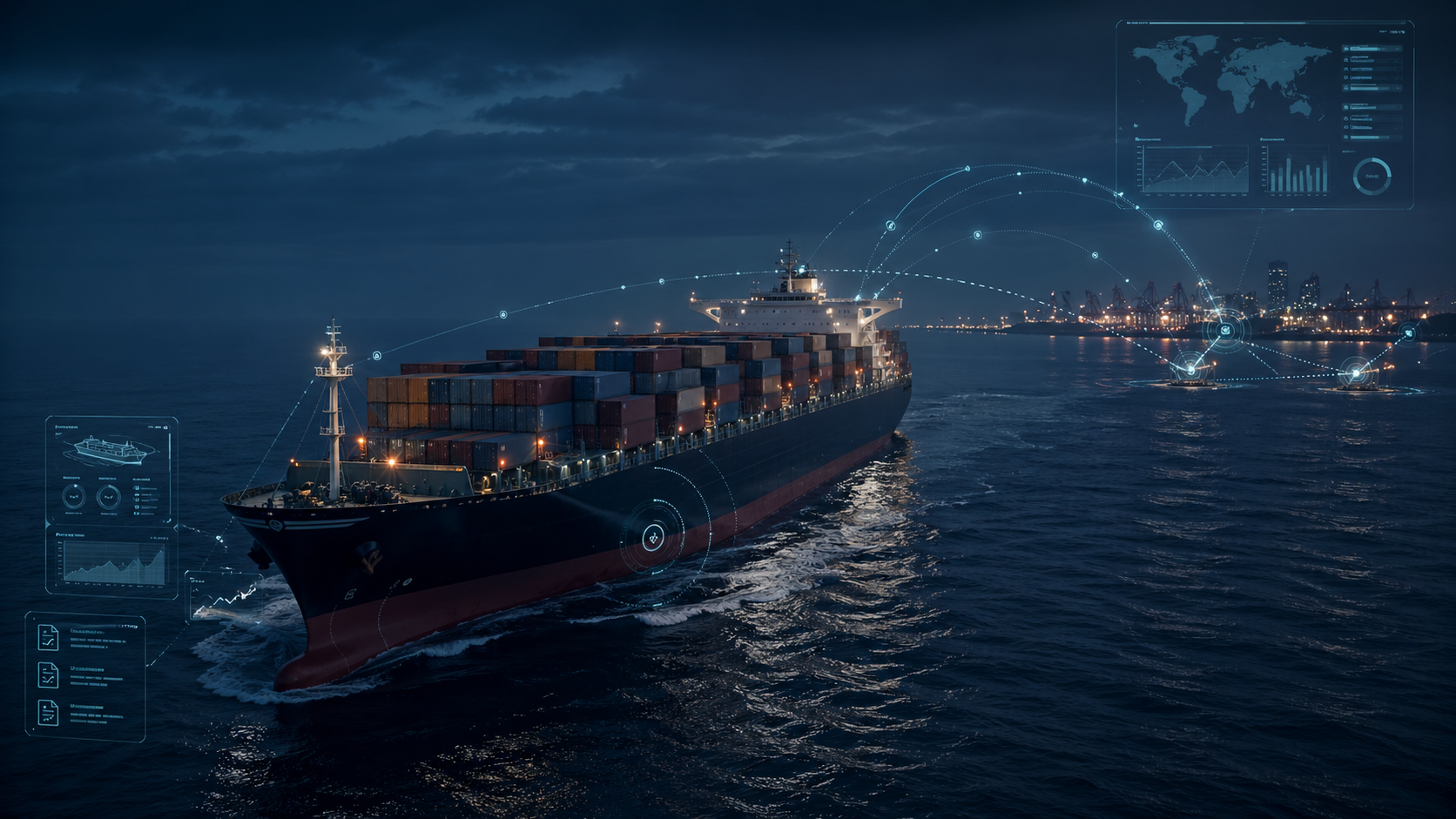
A $200 million container vessel. Fifteen onboard systems generating data around the clock. The port operations team learns about a three-hour delay via a phone call from the captain.
That scenario is not a story from 2010. According to Maritime Executive, it is still a daily operational reality for shipping companies that have added digital tools on top of legacy infrastructure without rethinking how data actually flows between vessel and shore.
2026 is a breakthrough year for maritime digitalisation. Most industry analysts agree on that. But a breakthrough year is not the same as a solved problem. The industry is moving. Two critical bottlenecks are slowing down the returns: vessel data connectivity and document intelligence. Both have measurable daily costs. Neither gets enough engineering attention in most maritime tech discussions.
Why Legacy Maritime Architecture Cannot Keep Up
Most commercial vessels were not designed for real-time data streaming. They were built around radio communication, paper logs, and scheduled port inspections. The software added over the past decade did not change that underlying architecture. It applied dashboards and monitoring tools to systems that still operate in isolation from each other.
The result is what integration engineers call the “15-system problem.” A modern vessel typically carries navigation software, engine monitoring, fuel consumption tracking, cargo management systems, crewing applications, maintenance logs, and communication platforms. Each stores data in a separate silo. There is no unified API layer. Shore-based operations teams pull data manually, query multiple interfaces, or wait for reports that arrive hours after the events they describe.
Vessel downtime costs up to $50,000 per hour. Much of that cost starts not with mechanical failure but with information that arrives too late to act on. An engine anomaly logged at 06:00 UTC that does not reach the technical superintendent until a scheduled 10:00 report is not a connectivity problem. It is an architecture problem.
Over 70% of shipowners and managers list cost reduction as their primary driver for digital investment. The ROI case for real-time integration is obvious. The engineering path to get there is not.
What FuelEU Maritime and CII Are Actually Asking From Operations Teams
Regulation has moved from abstract pressure to specific operational requirements. The EU FuelEU Maritime framework and Carbon Intensity Indicator (CII) requirements are generating documentation obligations for every vessel calling at European ports. Operations teams now produce EU MRV reports, FuelEU compliance statements, and CII rating documentation that feeds directly into commercial decisions: charter rates, port access approvals, and financing terms.
The maritime compliance landscape shifted from reactive to predictive in 2026. That shift means operations teams need access to real-time fuel consumption data and voyage performance metrics. End-of-voyage summaries are no longer sufficient for compliance reporting that affects commercial outcomes.
This is where vessel connectivity gaps become regulatory problems in real time. A ship that cannot stream its fuel consumption data cannot support predictive compliance. It can only document after the fact. In a market where CII ratings affect charter rates and access to trade lanes, that reporting lag carries a price tag.
Starting January 2026, all STCW certificates issued or revalidated must be in electronic format. That regulatory shift is part of a broader movement toward digital-first crew documentation. Platforms that support it are becoming the operational baseline. Those that do not are increasingly visible during port state control inspections.
When Faster Connectivity Is Not Enough
Starlink Maritime and 5G have resolved the bandwidth problem on most major commercial routes. Vessels that previously operated on low-bandwidth satellite connections can now stream continuous data. The infrastructure problem is largely addressed for new installations and many retrofits.
The problem that remains is on the software side. Real-time connectivity without a unified data model produces real-time noise rather than actionable insight. When fifteen onboard systems each run on different data schemas and reporting cycles, faster connectivity does not eliminate the integration problem. It accelerates how quickly inconsistent data reaches shore.
Wärtsilä’s 2026 analysis identifies lifecycle optimisation through unified platform data as one of the defining technical challenges for fleet operators this year. The goal is a digital twin that integrates owner, operator, charterer, port, and broker data into a single operational picture. The engineering prerequisite is a standardized API layer across all onboard systems and event-driven shore-side processing. Most commercial fleets are not there yet.
The Document Layer Maritime Teams Keep Underestimating
There is a parallel problem that rarely appears in maritime digital transformation discussions: the document intelligence gap inside ship management offices.
A ship management company running 20 vessels holds thousands of documents: ISM manuals, class certificates, port state control records, crew contracts, maintenance histories, and years of regulatory filings. That accumulated knowledge lives in shared drives, email threads, and folder structures that shift every time a fleet manager changes roles.
The operational cost is real but easy to dismiss as soft inefficiency. A compliance officer verifying early termination terms in a crew contract searches manually for 20 to 40 minutes. A port agent confirming certificate validity calls the fleet manager rather than pulling the record. A new operations team member trying to understand vessel-specific procedures reads through folders that have not been maintained in two years. Over a full operations team across a month, those searches represent hundreds of hours.
AI-assisted document processing in ship management is delivering 40-60% reductions in manual review time in documented deployments. That figure typically refers to the technical department. The back office carries the same problem with fewer tools designed for it.
Archidex addresses this directly. Built by Allmatics, it is a corporate document intelligence platform for teams working with large document archives. Upload your company’s document base — contracts, ISM manuals, compliance records, crew files, port state control histories, internal policies — and search it through a natural language chat interface. Ask a question, receive a sourced answer that shows the exact document, page number, and text fragment. No folder navigation. No manual search across multiple systems.
For maritime operations teams, that means a compliance officer can query the ISM manual for a specific procedure without reading 300 pages. A crew manager can confirm contract terms without searching through email archives. A fleet operations team can build a searchable knowledge base from years of accumulated documents without re-filing or restructuring anything.
The platform was designed for regulated-industry data requirements: no model training on client documents, no third-party data sharing, full GDPR compliance, SSO integration, role-based access control, and complete audit logs. Enterprise teams with self-hosting requirements have that option. Beta access is currently open, with plans starting at $8 per user per month.
Three Integration Patterns That Deliver ROI in 2026
For maritime SaaS teams and fleet operators building digital infrastructure, three architectural patterns are producing measurable results this year:
Unified telemetry layer first. Before adding AI, analytics, or predictive maintenance tools, teams that succeed in maritime digitalization establish a single telemetry API that normalizes data from all onboard systems into a consistent schema. This is unglamorous integration work. It is also the only foundation on which everything else functions reliably.
Event-driven shore-side processing. Rather than scheduled reports, vessels stream events — threshold breaches, maintenance triggers, fuel anomalies, position updates — to a shore-side event bus. Operations teams respond to events as they happen rather than reviewing end-of-day summaries. This is where the phone-call problem actually gets fixed.
Document intelligence as part of the operational layer. The vessel data platform and the document archive are two separate problems that most maritime tech teams treat as separate projects. The operations teams getting the highest returns from their digital investment are connecting them: real-time vessel data paired with the compliance records, procedures, and contracts that give it operational context. That combined layer is where knowledge-driven decision-making in maritime actually happens.
The Commercial Reality for Maritime Teams in 2026
The maritime industry is committing more to digital infrastructure than at any previous point. Nearly half of shipowners forecast digital savings exceeding $1 million annually, with 15% projecting savings above $10 million.
The ROI is there. It concentrates in teams that treat vessel connectivity and document intelligence as engineering problems to be built, not software subscriptions to be purchased.
Allmatics builds custom maritime technology, from integration architecture and real-time data infrastructure to AI-powered tools for operations teams. Archidex handles the document intelligence layer. The vessel data architecture is the platform it sits on.
If you are building in this space or assessing your current maritime tech stack, let us talk.