
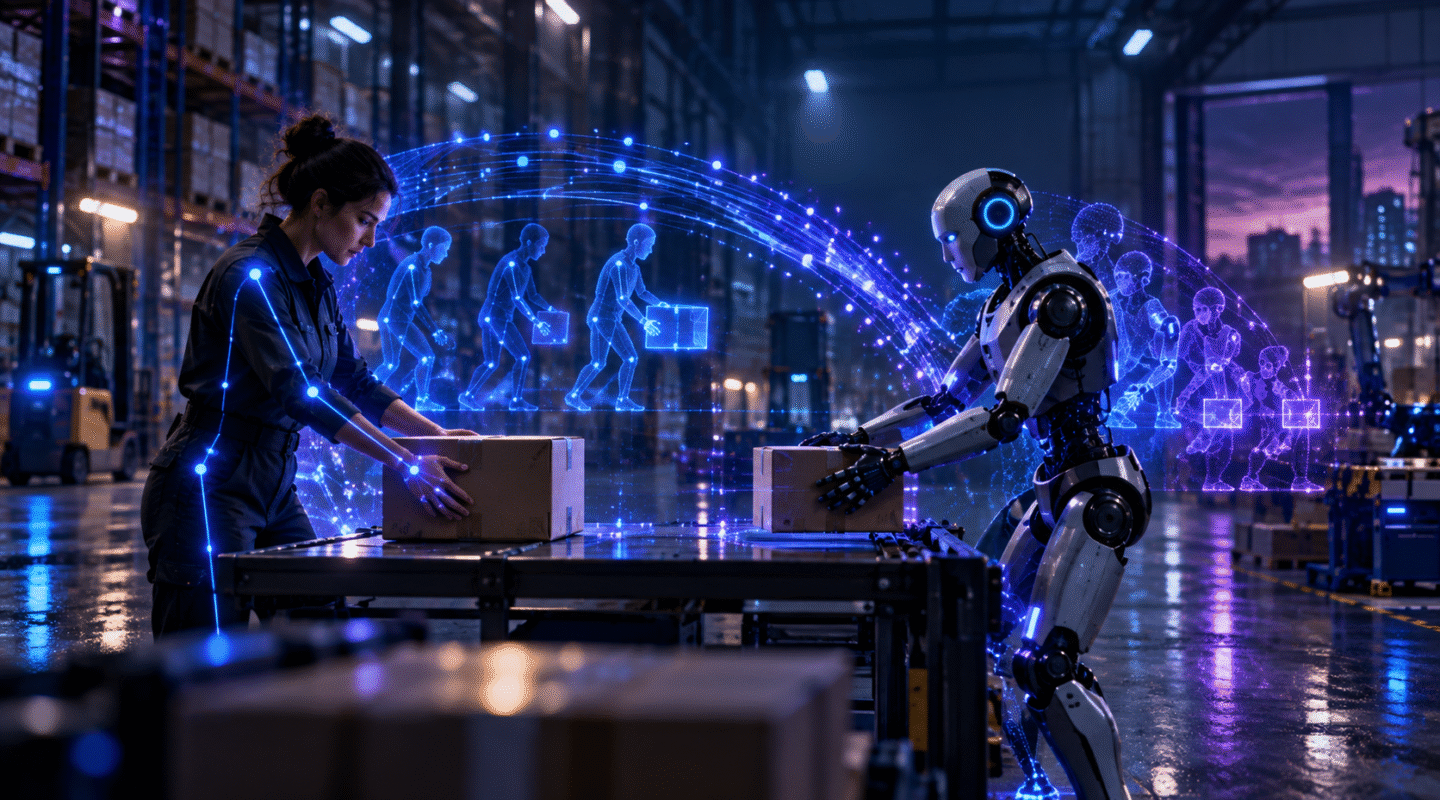
Humans Are Teaching Robots How to Replace Human Work. What Happens When the Lesson Is Finished?
A medical student in Nigeria finishes a hospital shift. At home, he straps an iPhone to his forehead and films ordinary household tasks. He folds laundry, makes a bed, washes dishes and cooks. This is not content for social media. It is training data for robots.
That detail sounds almost too neat for a future-of-work story, but it captures where physical AI is right now. Large language models grew up in a world humanity had already digitized: books, code, forums, images, video and documentation. Robots do not have the same advantage. The internet can explain what a chair is or describe how to fold a shirt. It has far less useful data about grip pressure, wrist movement, or the tiny corrections a person makes when fabric slips or a drawer sticks.
So one of the most futuristic industries on earth is doing something surprisingly old-fashioned. Companies are paying people to show machines how humans move through the physical world.
The internet taught AI to talk. The physical world is harder.
This data gap has been obvious in robotics research for years. Google DeepMind’s Open X-Embodiment project brought together data from 22 types of robots across more than 20 research institutions. Together, they created more than a million robot-training episodes across hundreds of skills and tasks. The point was not that one million demonstrations solved robotics. The opposite was true: collecting that much useful physical data required a scale of collaboration that one lab would struggle to reproduce.
That helps explain the rise of a new kind of labour market. Rather than relying only on robot-generated demonstrations, companies are capturing what humans already know how to do.
The human workforce behind robot training
MIT Technology Review reported on Micro1, a Palo Alto company recruiting contributors across more than 50 countries to record real-world activity for robotics training. One participant in Nigeria, a medical student, records tasks at home and earns about $15 an hour. The footage is intentionally mundane: folding clothes, cooking, cleaning, moving objects. That is exactly the point. Tasks that humans perform without thinking are often the ones we still need to teach robots.
This pattern is also appearing inside workplaces. The Guardian documented factory workers in India wearing head-mounted cameras while sewing, handling tools and performing production tasks. According to the report, some factories did not pay workers extra for the footage. The article also described EgoLab, an Indian data company that says Tesla is one of its major clients. Separately, Tesla has hired Data Collection Operators in the United States. Their job is to wear motion-capture suits and VR equipment while performing movements for Optimus training.
The economics vary widely. Some of this work resembles specialist motion capture and pays accordingly. Other jobs look much closer to global gig work. But the most interesting part is not the hourly rate. It is what companies are actually buying.
We are putting a price on muscle memory.
The tiny correction you make when a glass begins to slip is data. You grip cardboard differently from ceramic, and that is data too. So is the instinct to slow down when something feels fragile. Even the angle of your hand changes when a drawer is heavier than expected.
Humans rarely describe these decisions because we barely notice ourselves making them. Robotics is forcing us to notice just how much intelligence was hiding inside “simple” physical work.
Human demonstrations may only be the seed
The obvious objection is that this sounds impossibly expensive. If future humanoid robots need to watch a person perform every task thousands of times, the economics fall apart.
That is not the direction the industry is moving.
A more practical model is to use human demonstrations as seed data, then expand them with simulation and synthetic data. NVIDIA’s Isaac GR00T 1.7, for example, used roughly 32,000 hours of real demonstrations and first-person human data. NVIDIA added about 8,000 hours of simulated demonstrations and rollouts.
Researchers are also testing how little human data a model needs before it can transfer a skill to new robots and environments. In 2026, the HumanEgo paper reported a 92.5% average success rate across four test tasks using 30 minutes of first-person human video per task. That result came from a controlled research setting. It does not mean 30 minutes of video can teach a commercial humanoid any job. But it shows the likely scaling path: humans provide examples, software creates more training experience around them, and the model learns to apply the skill more broadly.
If that loop keeps improving, the bottleneck changes. The question stops being “Can we record enough human demonstrations?” and becomes “How quickly can a model turn limited human demonstrations into reliable physical behaviour?”
That is where the forecasts start to sound surreal.
Ten billion robots, one billion robots, or something much smaller?
Elon Musk has made the most aggressive public predictions. In 2024, he said there could eventually be at least 10 billion humanoid robots by 2040, with unit prices in the $20,000 to $25,000 range. He has also repeatedly described Optimus as potentially becoming one of Tesla’s largest businesses.
That does not mean 10 billion robots is a forecast we should treat as a base case. Other estimates are dramatically lower.
Morgan Stanley sees a path to more than one billion humanoid robots by 2050, with adoption remaining relatively slow through the first half of the 2030s before accelerating. Its analysts expect industrial and commercial settings to account for most of those robots, with far fewer in homes.
Goldman Sachs is more conservative again. Its published outlook estimated that the humanoid robot market could reach $38 billion by 2035, with around 1.4 million humanoid shipments in that year.
These numbers use different methodologies and time horizons, so lining them up as if they were competing answers would be misleading. What matters is the spread. Depending on whose assumptions you accept, humanoids could become one of the largest technology platforms in history, or remain a much narrower industrial category for far longer than the hype suggests.
Reality in 2026 sits somewhere between the demo stage and the mass-market fantasy. Boston Dynamics has not deployed Atlas at scale. Hyundai is targeting manufacturing capacity of 30,000 humanoid robots annually by 2028. That is a serious production ambition, but it is still several orders of magnitude away from a world with billions of humanoids.
The robot apocalypse is probably not arriving all at once.
That does not mean nothing is happening.
BMW gives us a useful picture of what the early phase actually looks like. At its Spartanburg plant, Figure 02 humanoid robots took part in a ten-month production pilot. BMW says the system supported production involving more than 30,000 BMW X3 vehicles, moved more than 90,000 components, accumulated around 1,250 operating hours and walked roughly 1.2 million steps. BMW has since expanded humanoid testing to its Leipzig plant.
That is not a general-purpose robot replacing a person in every context. It is a robot doing useful work inside a structured industrial environment.
And that distinction matters.
Factories are easier than homes. A predictable production cell is easier than a kitchen with pets, children, clutter, wet surfaces, changing objects and endless exceptions. Warehouses, manufacturing lines and repetitive logistics workflows offer clearer constraints, better safety boundaries and more measurable ROI.
Humanoids do not need to become universally competent before they become economically important. They only need to become reliable enough at a meaningful set of tasks.
So what happens to jobs?
This is where the conversation usually jumps too quickly from “robots are improving” to “there will be no work left.”
Current labour forecasts do not support that simple conclusion. The World Economic Forum’s Future of Jobs Report 2025 projected that technological, demographic and economic shifts would create 170 million jobs and displace 92 million by 2030, for a net increase of 78 million roles. The International Labour Organization has also warned against treating AI exposure as equivalent to job elimination; its work on generative AI suggests transformation is more likely than complete replacement for many occupations.
But there is an important caveat: much of the labour debate so far has focused on software AI.
Writing, coding, analysis, customer support, administration and design became obvious targets because generative AI lives on computers. Physical AI changes the equation. It brings automation into jobs that once seemed protected for a simple reason: someone had to act in the physical world. They had to pick something up, move through space, use a tool or react to an unpredictable environment.
That does not automatically lead to mass unemployment. It may lead to a different kind of productivity shock.
A single person working with software agents and physical robots could produce far more than one person does today. Some jobs will disappear or split into smaller tasks. Others may shift toward supervision and handling exceptions. New roles will also appear around deployment, safety, data, coordination, maintenance and system ownership.
The more useful question is not “Will humans still have value?” It is “Which kinds of human value become scarce when doing becomes cheaper?”
The value shifts from doing to deciding
For years, we reassured ourselves that physical work would remain human because machines lacked dexterity. Then, as humanoids improved, the reassurance moved to creativity, empathy and judgment. That may also prove too simplistic.
A more durable advantage may lie in deciding what should be done, knowing when the rules no longer fit, taking responsibility and resolving conflicting goals. Trust and system design may matter more too. Not because machines could never learn these skills, but because every new layer of automation creates new layers of coordination and accountability.
There is also a strange irony here. Before robots reduce the value of some human labour, they may force us to appreciate how sophisticated that labour always was.
A person folding fabric, stocking a shelf or handling a tool is constantly making tiny perception-and-control decisions. Until somebody tried to teach a robot the same task, much of that knowledge was economically invisible.
Now companies are recording, labelling and selling it.
We may be the generation that teaches machines the physical world
At Allmatics, we do not build humanoid robots. That is exactly why the topic is interesting to us without needing to pretend otherwise.
We work in the layers immediately around this shift: AI/ML, embedded systems, IoT, connected devices, cloud infrastructure and software that interacts with the physical world. In projects like ReadU6, AI and NLP sit inside a wider product that also includes custom embedded hardware, IoT, web/mobile software and real-time processing. The product is interesting not because it is “AI-powered,” but because intelligence has to work as part of a physical, connected system.
Humanoid robotics pushes that same systems problem much further.
Once software starts acting in the physical world, model performance becomes only one part of the architecture. Sensors, connectivity and latency matter. So do local versus cloud computing, updates, observability, security, failure modes and ownership of bad decisions.
A chatbot can hallucinate an answer. A physical system can move the wrong object, apply too much force or fail at the wrong moment.
That is why the next wave of AI may be less about putting a model into every product. The harder job is engineering systems people can trust when AI has the ability to act.
Teams building AI-enabled connected products should map these boundaries during Product Discovery before they harden into production constraints.
We may be teaching machines how to become more capable, but for now, we still believe there is real value in working with humans who care.
At Allmatics, that means a highly personal approach, direct communication and a team that gets deeply involved in the products we build.
So, until the robots take over, we’re here — building software with humans, for humans. If you have an idea worth building, let’s talk.
The strangest part of the robot revolution
Maybe the most interesting thing about humanoid robots is not that machines are becoming more human. It is that teaching them is forcing us to notice how much human intelligence sits below language.
For the first wave of AI, we gave machines the products of our minds: text, code, images, documents and conversations. For physical AI, we are beginning to give them the behaviour of our bodies.
We are, in a very literal sense, building a dataset of ourselves.
That does not tell us whether there will be one million humanoids in a decade or ten billion. It does not tell us which jobs will disappear or which new ones will replace them.
But it does make one question difficult to avoid.
What happens when the machines have learned enough from watching us?