
You can spend 18 months building a healthcare AI product that looks strong on paper.
Model performance is solid. Compliance review is complete. EHR integration is live. The demo works. The pilot looks promising.
Then the product reaches real clinical work, and adoption stalls.
This is the gap healthtech teams keep running into in 2026. The hard part is no longer only “Can we build it?” The harder question is: will physicians actually trust it and use it when the clinic is full, the schedule is behind, and every extra click feels expensive?
That is where many healthcare AI products break down.
What Physicians Are Actually Saying
Physician discussions about AI are rarely as simple as “AI is good” or “AI is overhyped.” The more useful signal is much more practical: does the tool reduce work, fit the clinical workflow, and produce output that is easy to review?
Informal conversations in communities such as r/medicine, r/FamilyMedicine, and r/emergencymedicine are not clinical evidence. They should not be treated as research. But they are useful for understanding adoption friction. Physicians tend to talk about editing time, note quality, patient presence, privacy, and whether a tool saves work from the first encounter.
That nuance matters.
A physician does not adopt an AI tool because it passed a benchmark. They adopt it when it solves a specific problem in a way that respects how clinical work actually happens.
Specific tool. Specific pain. Minimal workflow disruption.
That is the difference between healthcare AI that gets tested and healthcare AI that becomes part of daily practice.
The Numbers Behind the Hype
Ambient AI documentation is one of the clearest examples of healthcare AI adoption because it addresses a problem clinicians already feel every day: documentation burden.
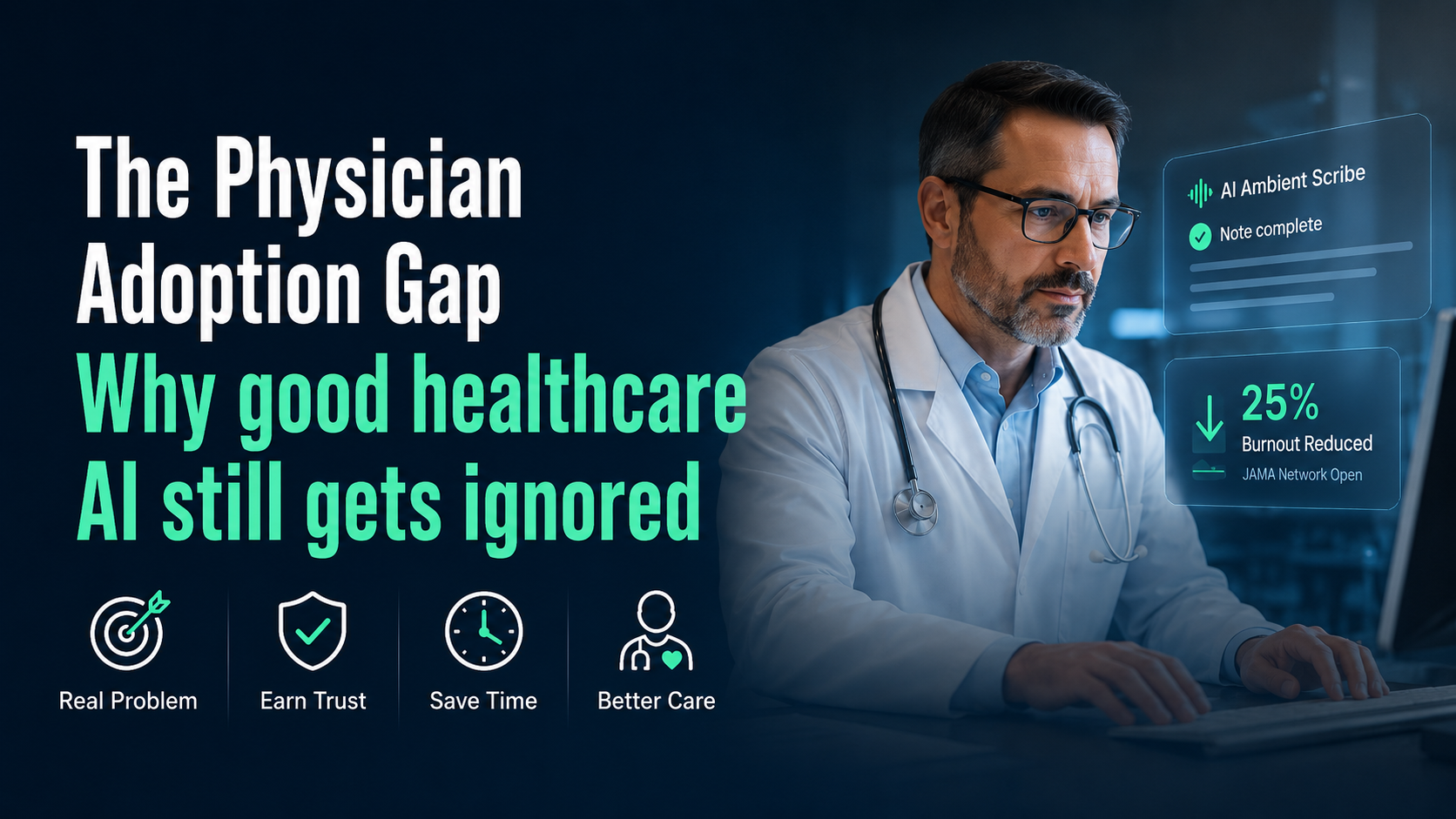
A multicenter quality improvement study published in JAMA Network Open evaluated ambient AI scribes among physicians and advanced practice practitioners across six U.S. health systems. After 30 days, burnout among users fell from 51.9% to 38.8%, while reported well-being improved.
The American Medical Association summarized the same study as evidence that ambient AI scribes can reduce administrative burden and physician burnout, while also noting that these tools are being watched closely because documentation remains one of the most painful parts of clinical practice.
The important detail is not that ambient AI is “magic.” It is that it targets a workflow physicians already want to improve. Notes are not a theoretical pain. They are a daily tax on clinical time, attention, and energy.
That is why ambient documentation has become one of the most visible healthcare AI use cases in 2026.
Health systems are moving in that direction. Mount Sinai Health System announced in November 2025 that it had begun rolling out Microsoft Dragon Copilot in select departments, with plans to expand system-wide in 2026. Each phase includes training, feedback, and evaluation to support secure and effective adoption.
Athenahealth is also moving ambient AI deeper into the clinical workflow. According to Becker’s Hospital Review, athenahealth introduced athenaAmbient, with user testing planned from February 2026 and broader encounter experience testing scheduled across the first half of the year. The company said the capability would be included in standard software updates at no additional cost to customers.
This is what real adoption pressure looks like. Healthcare organizations are not only buying “AI.” They are looking for AI that removes visible friction from existing work.
Why Healthcare AI Fails at Adoption
After working with healthtech teams across the U.S. and UK, we see the same adoption problems appear again and again. The product may be technically correct. The model may perform well in controlled evaluation. The integration may be functional.
But physicians still do not use it.
Usually, the reason sits in one of three places.
1. It solves the engineer’s problem, not the physician’s problem
Many healthcare AI products start from a technical opportunity: “we can predict X,” “we can flag Y,” or “we can classify Z.”
That may be valuable. But physicians do not experience their work as a set of abstract prediction tasks. They experience it as overloaded schedules, unfinished notes, inbox messages, prior authorization delays, referral noise, and clinical uncertainty that has to be handled quickly.
A tool that predicts something interesting but adds another review step may not feel helpful. A tool that saves 15 minutes of evening documentation can feel useful immediately.
This is why ambient AI scribes gained attention so quickly. They do not ask physicians to care about model architecture. They reduce a pain point clinicians already understand.
2. Trust is earned in the first session
Healthcare AI does not get unlimited chances.
If the first output is confusing, incomplete, or takes too long to correct, the physician learns something very quickly: this tool creates work.
That impression is hard to reverse.
The first encounter matters because it sets the physician’s mental model. Is this tool reliable? Does it understand the context? Can I review it quickly? Does it help me move faster, or does it become one more system I have to manage?
For clinical AI, trust is not a brand message. It is a product experience.
3. It requires behavior change that was never negotiated
The best healthcare AI products fit into workflows that already exist.
Physicians should not have to open a separate system, remember a new habit, or change how they document unless the value is obvious. If a tool requires a new login, a new dashboard, or a new review process, the adoption burden rises immediately.
That does not mean clinical workflows should never change. Sometimes they should. But the product has to earn that change.
If the behavior change cost is higher than the perceived benefit, adoption fails even when the AI is technically strong.
Trust Is Also a Governance Problem
In healthcare, trust is not only UX.
It also means consent, auditability, data governance, privacy, and clear physician oversight. Ambient AI tools can reduce administrative burden, but they also introduce risks if clinical notes contain inaccuracies, if patients do not understand when recordings are used, or if data flows are not designed carefully.
Reuters has reported that ambient scribing creates new legal and regulatory questions around consent, privacy, hallucinations, liability, and state-level rules. These concerns do not cancel the value of ambient AI. They define the standard for building it responsibly.
A physician-facing AI product needs more than a strong model. It needs a clear operating model:
- what the AI can and cannot do;
- where the source data comes from;
- how outputs are reviewed;
- who remains accountable;
- how consent and privacy are handled;
- how errors are tracked and corrected.
Without that foundation, even a useful product can lose trust.
What Production-Ready Healthcare AI Actually Looks Like
When we built an AI-powered telemedicine platform for one of our clients, the question we kept returning to was not only “how do we make the model more accurate?”
It was: how do we make physicians trust this within the first 10 minutes of use?
Three design principles shaped the answer.
Transparency, not black boxes
Every AI suggestion included a visible reasoning trail. Physicians could see why the system flagged something, not just what it flagged.
That changed the interaction. The physician did not have to blindly accept the output or reject it on instinct. They could check the reasoning quickly and decide whether the suggestion was useful.
In clinical work, that matters. A black box asks for trust. A transparent system earns review.
Integration without disruption
The AI layer appeared inside the existing clinical workflow.
No new tab. No separate dashboard. No context switch. Suggestions appeared where physicians were already working, at the moment they were already making a decision.
That small product decision made the AI feel less like another tool and more like support inside the workflow.
Calibrated confidence
The system was explicit about what it knew and what it did not know.
High-confidence suggestions were presented directly. Lower-confidence flags were framed as questions, not answers. The physician could quickly understand when the AI was offering a strong signal and when it was asking for human judgment.
That distinction helped users build the right mental model: this is a tool I direct, not a system I have to fight.
The result was adoption without forcing a heavy training mandate or a large change management program. Physicians used the features because they were useful at the moment they appeared, and because the system did not ask them to trust what it had not earned.
The 2026 Pattern
Healthcare AI that works in 2026 tends to share one trait: it removes draining work from clinical and operational teams without asking them to rebuild their day around the tool.
That includes ambient documentation. It also includes prior authorization automation, referral intake, scheduling optimization, document processing, clinical inbox routing, and revenue cycle workflows.
None of this is as flashy as a general-purpose medical AI assistant. But it is where adoption is becoming real.
According to Fierce Healthcare’s coverage of the 2026 Eliciting Insights survey, 75% of U.S. health systems are now using at least one AI application, up from 59% in 2025. The same report points to clinical note-taking as one of the most commonly adopted AI use cases.
The lesson for healthtech teams is clear: adoption is not driven by the most impressive model. It is driven by the most specific workflow improvement.
A product that saves time, reduces review work, and gives clinicians control has a chance. A product that adds another layer of complexity does not.
What This Means for HealthTech Builders
If you are building healthcare AI in 2026, model accuracy matters. Compliance matters. EHR integration matters.
But they are not enough.
The real benchmark is whether a physician can trust the tool during the first real session.
That question is answered by the product, not only by the model. It depends on the specificity of the problem, the quality of the first user experience, the clarity of the output, and the degree to which the tool fits into existing clinical work.
Physicians are not waiting for another AI dashboard. They are waiting for fewer unfinished notes, fewer duplicate steps, fewer inbox delays, and fewer systems that ask for attention without giving enough back.
Healthcare AI will keep passing technical benchmarks. The products that win will be the ones that pass the clinical workflow test.
Can a physician use it when the day is already behind schedule?
Can they check the output quickly?
Can they stay in control?
Can they feel the value before the product asks for a new habit?
That is the standard healthcare AI should be designed to meet.
Building a healthcare AI product and running into physician adoption challenges?
At Allmatics, we help healthtech teams bridge the gap between technically correct and actually trusted, from architecture decisions to physician-facing UX.
If your product works in a demo but struggles in real clinical workflows, let’s look at where adoption is breaking.