
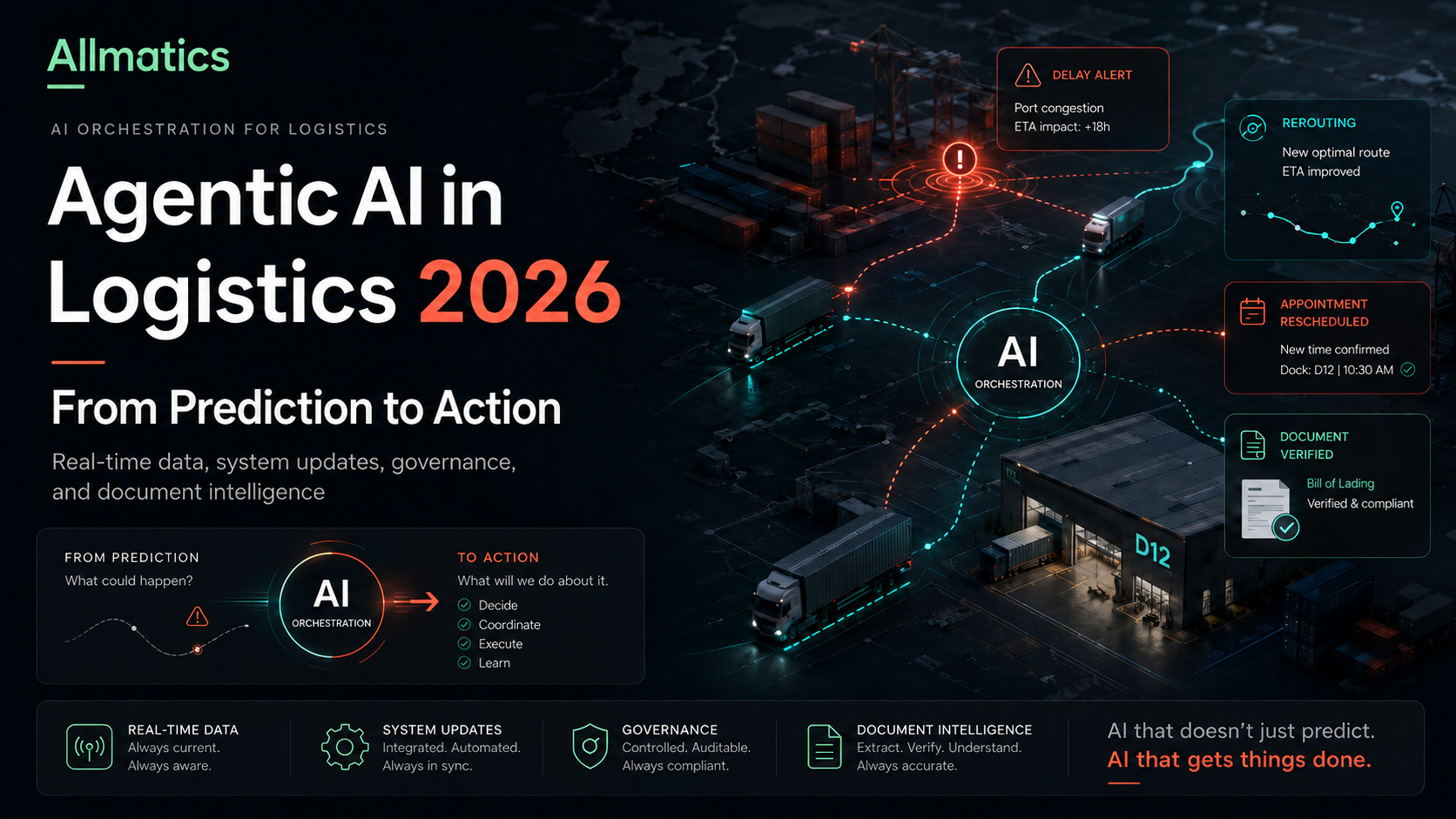
In 2026, the serious question for logistics companies is no longer “Do we use AI?”
Most do, at least somewhere.
The better question is: can your AI act, or does it only advise?
Predictive models can warn that a shipment may arrive late. Dashboards can show that warehouse capacity is under pressure. Planning tools can recommend another carrier.
These signals help, but they still leave the work to people.
Someone still has to open the alert, check the context, confirm the decision, update the TMS, notify the carrier, adjust the warehouse plan, and document the change.
The shift from advice to action
Agentic AI changes the role of software in that chain. Instead of stopping at a recommendation, an AI agent can read the situation, compare options, take an approved action, monitor the result, and escalate only when the case falls outside defined rules.
This is the difference between AI that observes operations and AI that participates in them.
A predictive tool may say that a carrier will miss an appointment window. An agentic system can check available slots, contact the carrier, reschedule the appointment, update the WMS, notify the team, and flag the case only if something falls outside policy.
That shift has already started. Logistics Viewpoints describes 2026 as the moment when supply chain AI moves from technical capability toward measurable improvements in decision speed, service, inventory, resilience, and execution performance: Supply Chain AI Enters the Execution Era.
Reuters also reported that C.H. Robinson is moving into agentic AI to make freight brokerage operations faster and more efficient. Its CEO pointed to proprietary data and domain expertise as hard-to-copy advantages in an AI-driven freight market: C.H. Robinson CEO says AI will drive freight brokerage consolidation.
Other market examples point in the same direction. General Mills has been reported as using AI-driven supply chain optimization to evaluate more than 5,000 daily shipments and generate more than $20 million in savings since fiscal 2024: Agentic AI Examples, Enterprise ROI & Case Studies. HappyRobot, which has partnered with DHL, shows how AI agents can support driver follow-up calls, appointment scheduling, and warehouse coordination through phone and email workflows: Best AI Agents for Logistics and Supply Chain.
The exact numbers will vary by company, workflow, and data maturity. The direction is clearer than the statistics: logistics AI is moving from alerts toward controlled execution.
And that is where many companies hit the wall.
Why logistics AI gets stuck in advisory mode
Agentic AI in logistics is not a smarter chatbot connected to company data.
It needs an operational environment where action can actually happen.
A system can reroute a shipment only if it has live shipment data, carrier availability, route constraints, cost rules, and permission to update the system of record. Dock appointments create the same challenge: AI can reschedule them only when it can read the WMS, check time windows, contact the carrier, and write the new appointment back into the workflow.
Contract terms add another barrier. The system can apply them only if those terms are accessible, current, and verifiable.
That sounds obvious. In practice, this is where the architecture breaks.
Most logistics environments still run across a mix of ERP, TMS, WMS, spreadsheets, carrier portals, email threads, PDF agreements, customs documents, and local team knowledge. Data often arrives late. Systems use different formats. Documents that define commercial decisions often sit outside the operational stack.
This is why interoperability has become one of the most important topics in supply chain technology. Logistics Viewpoints argues that AI-enabled execution depends on whether the supply chain can operate as a connected decision network, not just whether one system can send data to another: Supply Chain Interoperability Is Becoming the Foundation for AI-Enabled Logistics.
There is also a broader adoption problem. SupplyChainBrain, citing recent reporting on generative AI pilots, notes that many enterprise AI initiatives fail to deliver meaningful outcomes: In 2026, Logistics Buyers Will Finally Realize That Outcomes Matter, Not AI. In logistics, that failure pattern is easy to understand. A model can work inside one tool, but operations rarely happen inside one tool.
The model may identify the issue. The business still needs the data, integration, permissions, and governance to let the system do something about it.
What agentic AI in logistics actually means
Agentic AI is often described as autonomous AI, but logistics teams should treat that word carefully.
Autonomous should not mean uncontrolled.
A useful logistics AI agent works within defined operational boundaries. It knows which actions it can take automatically, which cases need approval, when to escalate, and how to record what changed.
A practical agentic loop includes six steps:
- Perceive: collect signals from TMS, WMS, ERP, IoT devices, carrier APIs, email, documents, and external data sources.
- Reason: evaluate the situation against business rules, cost constraints, SLAs, capacity, risk, and contractual terms.
- Decide: choose the next best action within approved limits.
- Act: update systems, trigger workflows, notify stakeholders, generate documents, or request approval.
- Monitor: check whether the action worked and detect new exceptions.
- Escalate: involve a human when the case exceeds policy, confidence, value, risk, or compliance thresholds.
That last point matters. Strong AI systems do not remove people from logistics operations. They remove repetitive coordination from standard cases, so people can focus on exceptions, relationships, risk, and judgment.
Inbound Logistics makes a similar point in its 2026 outlook. AI creates value when teams apply it to specific use cases such as route optimization, ETA prediction, and resource planning: AI in Supply Chain Management: 2026 Outlook.
That is also the right lens for agentic AI. A broad “AI transformation” project is usually too vague. A better starting point is a workflow where decisions happen often, rules are clear, impact is measurable, and risk can be controlled.
The three architecture layers agentic AI needs
Moving from predictive AI to agentic AI requires more than a model upgrade. It requires an execution-ready architecture.
For logistics teams, three layers matter most.
1. Real-time operational data
Agentic AI cannot make today’s decisions from yesterday’s data.
If a shipment status changes only during a nightly sync, AI cannot respond reliably to a live delay. When carrier capacity sits in a spreadsheet that someone updates once a week, the system cannot safely recommend or trigger a booking. Warehouse constraints that appear only after someone exports a report arrive too late for real-time action.
Real-time data does not mean every company must rebuild every system from scratch. It means logistics companies need event-driven data flows, reliable APIs, normalized operational entities, and clear ownership of data quality.
The goal is not to centralize everything for the sake of architecture. The goal is to give AI a live and trustworthy operational picture.
2. Write-back access with governance
Many companies give AI read access.
That works for dashboards, summaries, alerts, and recommendations. It does not support agentic execution.
If AI can identify that a delivery appointment should change but cannot update the WMS, it remains advisory. When the system can recommend another carrier but cannot create a task, initiate a booking, or notify the team, the work still returns to humans.
Write-back access turns insight into action.
Logistics teams need to design that access carefully. A shipment reroute, carrier change, customs document update, or SLA-related decision can create financial and legal consequences. Agentic systems need role-based permissions, approval thresholds, audit logs, rollback paths, and clear policy boundaries.
The practical question is not “Should AI be allowed to act?”
The practical question is: which actions can it take, under which conditions, with what evidence, and who can review them later?
3. Document intelligence
This is the layer many AI roadmaps still underestimate.
Logistics operations do not run only on structured data.
They run on carrier contracts, tariff sheets, service-level agreements, insurance policies, customs instructions, CMRs, bills of lading, commercial invoices, certificates of origin, packing lists, claims documents, and local operating procedures.
A TMS may know the shipment status. Contract details often sit elsewhere. The exact demurrage clause, route-specific tariff, fallback carrier agreement, or insurance exclusion may live only inside a document.
That information still shapes the right next step.
If an AI agent cannot retrieve and verify it, it cannot safely act on it.
The document layer that blocks autonomous logistics decisions
Imagine a cross-border shipment approaching an SLA threshold. AI sees the delay risk and finds a possible response: apply the demurrage rule, notify the customer, and move the next leg to a backup carrier.
From a workflow perspective, the action looks simple.
From a logistics perspective, the system needs answers first:
- What is the exact SLA threshold for this customer and route?
- Which demurrage clause applies?
- Does the agreement approve the backup carrier for this lane?
- Is the tariff still valid?
- Do customs instructions affect the timing?
- Does the cargo insurance policy create special handling requirements?
In many companies, those answers do not exist as clean structured fields. They sit across PDFs, scanned documents, spreadsheets, email attachments, shared folders, and old contract versions.
That is why document intelligence becomes part of the agentic AI architecture.
Without it, the agent sees the operational signal but lacks the commercial and contractual context required to act responsibly.
Why this problem affects human teams too
The same issue slows logistics coordinators, operations managers, and customer-facing teams every day.
A new coordinator joins and spends the first weeks learning where documents live, which contract version is current, which tariff applies to which corridor, and who knows the answer when a file name is unclear.
This is not only an onboarding problem. It affects daily work across 3PLs, freight forwarders, and supply chain teams managing many carrier relationships.
A senior dispatcher may know which fallback carrier can take a route. A finance manager may remember where the payment terms sit. A customs specialist may know which instruction was updated last month. But if that knowledge lives in people’s heads, email threads, and folder habits, it cannot support autonomous execution.
Strong people lose time because operational knowledge is buried.
AI agents face the same limit. If the system cannot access the source, it should not make the decision.
Where Archidex fits into agentic logistics architecture
This is where document intelligence stops being a “search tool” and becomes an execution layer.
Archidex is a document intelligence platform built by Allmatics for teams that work with large operational archives. Logistics teams can upload contracts, tariff matrices, SLAs, customs instructions, cargo specifications, insurance policies, claims documents, and internal procedures.
The platform makes that archive searchable in natural language and returns answers with source references, so teams can see where each answer came from.
Verified context for people and AI agents
For a logistics manager, this means fewer interruptions and less time spent hunting through folders.
For an AI agent, it means something deeper: access to verified operational context.
A shipment exception agent could query Archidex for the applicable demurrage threshold. A carrier coordination agent could check whether a fallback carrier is approved for a route. A customs support agent could retrieve the latest instruction for a document pack. A finance workflow could verify the payment terms attached to a specific customer agreement.
The important part is not only that AI receives an answer.
The important part is that the answer traces back to a real document instead of coming from memory or incomplete context.
Security and governance for sensitive logistics documents
Logistics companies also need strong security around this layer. Client files should not train third-party models. Access should follow user roles. Searches and actions should leave audit trails. Enterprise teams may also need self-hosting or stricter data residency options.
These requirements are not secondary details. They make document intelligence usable in real logistics environments.
Archidex can support both human teams and AI-enabled workflows. A human user can ask which tariff applies to a route. An AI workflow can retrieve the same source-backed answer before generating a task, preparing a message, or escalating a case.
That is the real value of document intelligence in agentic logistics: it turns scattered operational documents into context that software can use safely.
A readiness check for logistics teams
Before investing in agentic AI, logistics companies should ask a few practical questions.
Start with live data. Does the system access shipment, inventory, warehouse, carrier, and customer information in time to support real action?
Then check system access. Can AI write back to the tools where operational work actually happens?
Next, look at documents. Can the system retrieve verified contract terms, tariffs, SLA rules, insurance conditions, and customs instructions?
Governance matters too. Can every action be logged, reviewed, and explained?
Finally, review approval rules. Do teams have clear thresholds for automatic action and human approval?
If the answer is no, the company may still benefit from predictive AI, copilots, analytics, and workflow automation. But it is not yet ready for full agentic execution.
That is not a failure. It is a roadmap.
What architecture teams should build first
The companies that will benefit most from agentic AI in logistics are not always the ones with the biggest AI budget.
They are the ones that prepare the operational foundation.
That foundation usually includes:
- API-first integration across ERP, TMS, WMS, carrier systems, customer portals, and internal tools.
- Event-driven data flows for shipment status, capacity changes, inventory movement, appointment updates, and exceptions.
- A normalized data layer that gives AI a consistent view of shipments, customers, carriers, locations, assets, costs, and documents.
- Secure write-back mechanisms with role-based permissions and approval logic.
- Document intelligence for contracts, tariffs, SLAs, customs instructions, claims, insurance, and compliance records.
- Auditability, monitoring, and human escalation paths for every meaningful AI-triggered action.
This is engineering work.
It is also where the real value appears.
Agentic AI does not become useful because the model sounds impressive. It becomes useful when the model connects to clean data, operational systems, governed actions, and verified business context.
From prediction to action
Logistics has spent years investing in visibility.
Visibility matters, but visibility alone does not move the shipment, update the appointment, check the contract, notify the carrier, or reduce manual work behind every exception.
The next stage is execution.
Agentic AI in logistics helps teams move from signal to action safely. That requires more than a model. It requires real-time data, interoperability, write-back access, governance, and access to the documents where operational truth often lives.
For many logistics teams, the fastest path forward is not a giant transformation program. It is one high-volume workflow where decisions repeat often, rules are clear, and the cost of manual coordination is visible.
Practical starting points for agentic AI
Good starting points include:
- Carrier appointment scheduling.
- Shipment exception handling.
- Tariff and contract lookup.
- Customs document checks.
- SLA monitoring.
- Claims preparation.
- Driver follow-up and carrier communication.
- Warehouse coordination for standard cases.
These workflows give agentic AI a practical path from concept to measurable operational value.
Allmatics builds logistics technology for companies that need more than another dashboard. We help teams design the architecture behind AI-enabled execution: integrations, real-time data infrastructure, workflow automation, AI tooling, and document intelligence systems.
If your logistics AI still stops at recommendations, the next step is not just a better model.
It is the architecture that lets AI act responsibly.
Talk to us if you are building or re-architecting a logistics platform and want to close the gap between prediction and action.