
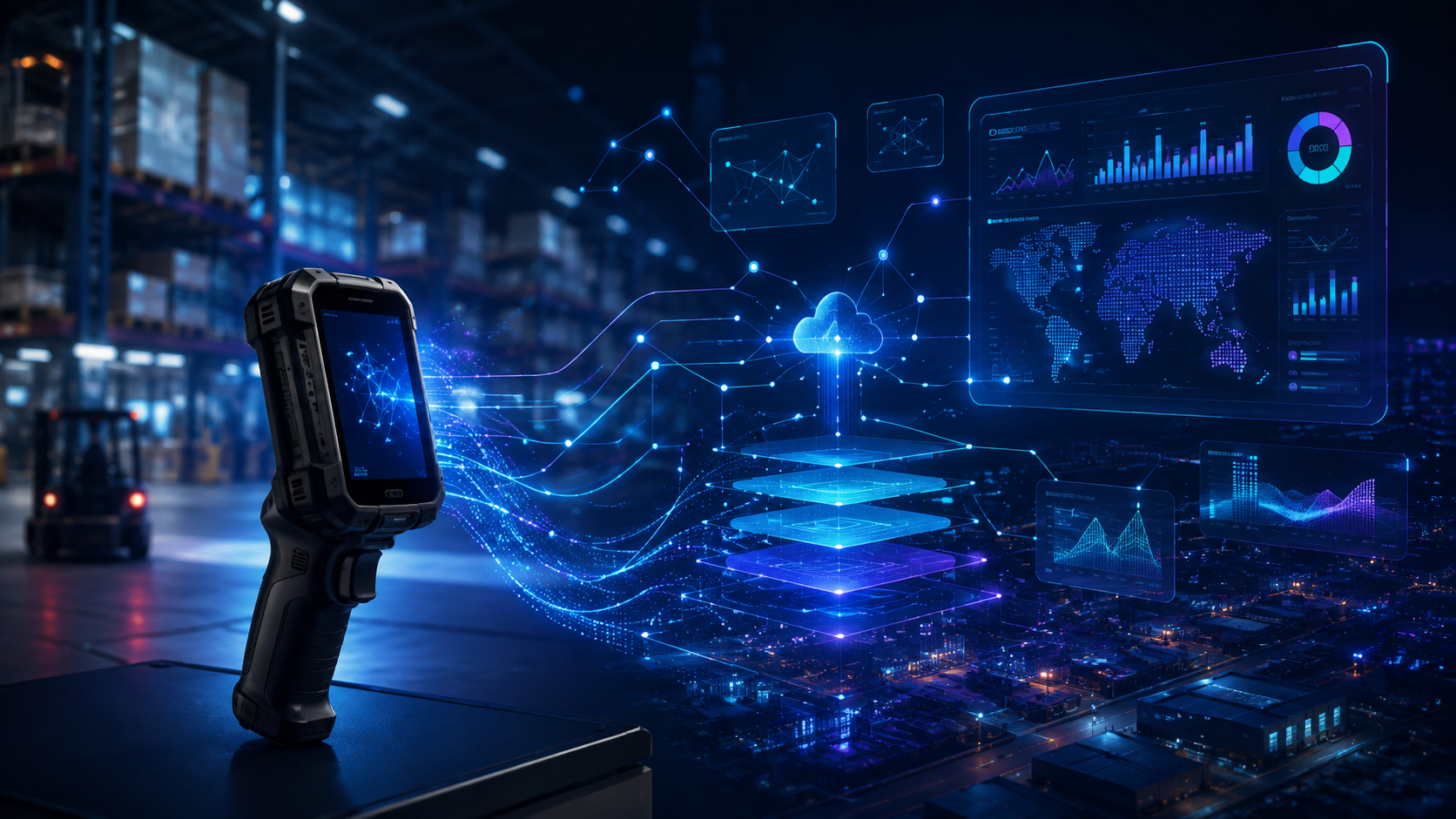
Why Logistics Hardware Companies Need a Software Layer, Not Just a Better Device
A barcode scanner can complete thousands of reads during a shift and still leave the manufacturer with almost no understanding of what happened around those reads.
Which devices were used most heavily? Which barcode types caused repeat attempts? Did one warehouse lose time because of battery degradation, poor connectivity, or an application problem? Which units are approaching maintenance?
Hardware alone rarely answers these questions. It records an action. The software layer gives that action context.
That distinction matters more in 2026 because logistics hardware is moving into connected operating environments. Gartner describes physical AI as the combination of AI models, IoT sensors, robotics, and automation systems that support real-time sensing, analysis, and execution across warehouses, transportation, and manufacturing.
The 2026 MHI Annual Industry Report, developed with Deloitte and based on responses from more than 500 supply chain leaders, found that 56% of organisations expect to increase spending on supply chain innovation. More than half plan to spend over $1 million, while 17% expect to spend more than $10 million. The report’s harder point is that buying technology is not enough. Results depend on how well companies integrate and operationalise it across connected, real-time networks.
For manufacturers of rugged mobile computers, scanners, printers, sensors, telematics units, and warehouse equipment, the product boundary has shifted. Customers still care about scan speed, drop resistance, battery life, ingress protection, and repairability. They also expect visibility, remote control, integration, and evidence that the device improves an operational process.
A stronger casing can extend the life of a device. A software layer can extend the life of the product line.
What the software layer actually includes
For logistics hardware, it usually includes several connected components:
- an application on the device or at the edge;
- secure device identity and configuration;
- telemetry on usage, errors, battery condition, connectivity, and performance;
- APIs or middleware connecting the device to WMS, TMS, ERP, inventory, or customer systems;
- a cloud or on-premise platform for storage, management, and analytics;
- dashboards for operations, support, and product teams;
- update, access-control, audit, and vulnerability-management processes.
Not every product needs all seven. A handheld scanner may begin with an Android application and a web dashboard. A fleet telematics unit may require edge processing, event streaming, and integrations with route-planning and maintenance systems.
The architecture depends on the use case. The business logic is consistent: the device becomes more useful when its data can be interpreted, managed, and connected to the customer’s workflow.
Zebra’s June 2026 warehouse guidance makes the same practical point. Warehouse modernisation works when rugged devices are intentionally connected to intelligent software platforms. With the right software, devices can also gain new workflow capabilities without waiting for a full WMS replacement.
Why a better device eventually reaches a ceiling
1. The manufacturer cannot see how the product is used
A device can be technically reliable while being poorly matched to the real workflow.
Perhaps one model performs well with standard barcodes but causes repeated attempts with damaged labels. Perhaps a unit advertised for a full shift loses capacity after months of cold-storage use. Perhaps customers deploy devices in ways the product team never anticipated.
Without telemetry, product decisions depend on support tickets, periodic customer calls, and isolated field reports. Those inputs tend to capture the loudest problems, not the most frequent patterns.
A software layer can show usage by device, user, site, shift, barcode type, application version, or task. It gives the manufacturer a clearer answer to a basic product question: what is the hardware actually doing after it leaves the warehouse?
2. Support remains reactive
When support has no access to device status, every incident begins with reconstruction.
What model is affected? Which operating-system build is installed? Was the device online? Did the scan engine fail, or did the application reject the data? Is the issue limited to one site?
Remote diagnostics, logs, fleet status, and controlled updates reduce that ambiguity. They also help separate hardware defects from application, network, and workflow problems.
This does not remove the need for field service. It makes field service less blind.
3. The device is disconnected from the operational system
A successful scan has little value if the resulting data is entered into the wrong record, delayed in a queue, or passed to another system without context.
The software layer decides what happens after the beep:
- Validate the barcode.
- Associate it with a user, location, order, asset, or shipment.
- Apply the relevant business rules.
- Update the operational system.
- Confirm the action to the employee.
- Retain an auditable event.
This is where hardware begins to affect inventory accuracy, picking, receiving, traceability, maintenance, and customer service.
The need for that chain is becoming more visible as identification standards evolve. The GS1 2D Barcode Playbook released in 2026 explains that the migration to richer barcodes requires more than compatible scanners. Middleware, ERP, inventory, fulfilment, and analytics systems may all need updates to process batch, serial, expiry, and product-version data.
Reading the code is one task. Making the data operational is another.
4. Product differentiation becomes easy to copy
Hardware specifications converge. Competitors can source similar processors, scan engines, screens, radios, and enclosures. Price and availability then carry more weight.
A software platform creates a harder-to-copy layer around the device:
- historical performance data;
- customer-specific workflows;
- integration templates;
- fleet-management tools;
- analytics;
- administrator roles;
- APIs;
- update and support infrastructure.
These capabilities reduce the amount of work customers must perform around the hardware.
They can also support subscriptions for analytics, fleet management, premium support, benchmarking, or workflow modules. The exact model depends on the market, but recurring value requires recurring utility.
A real example: adding analytics to rugged scanning hardware
Allmatics worked with a UK company that manufactures rugged mobile devices for logistics and warehousing. The client wanted to add a web and mobile system capable of collecting and analysing barcode-scanner usage.
The company had no in-house software development team. Before committing to the product, it needed enough technical clarity to understand whether the idea was feasible, what the system would require, and how quickly an MVP could be delivered.
The project started with a two-week discovery phase. A seven-person team then built the initial software in approximately two and a half months, followed by testing on the client’s devices.
The MVP included:
- an Android application for barcode scanning and data collection;
- a web application for analytics and user management;
- a server environment;
- a Product Requirements Document;
- device-agnostic comparison of scanning performance.
The platform tracked activity by device, user, and day. It could surface scanning frequency, commonly used barcode types, scan timing, device-utilisation patterns, and comparative performance across scanners.
The collected data also created a foundation for maintenance planning, including closer monitoring of operating hours and battery life cycles.
The decisive outcome was the change in the client’s product. The company moved from selling rugged equipment with limited visibility after deployment to offering hardware supported by usage analytics and a customer-facing software experience.
Discovery took two weeks. The MVP was ready in roughly three months.
There are no public figures showing a specific revenue increase or percentage reduction in downtime, so we will not manufacture one. The confirmed result is narrower and still commercially relevant: the software component increased the product’s utility and gave customers operational data they did not previously have.
Read the full Allmatics barcode-scanning analytics case study.
Five capabilities worth designing first
Hardware companies sometimes begin with a long feature list. A stronger starting point is a small set of capabilities connected to actual operational decisions.
Device identity
Every event should be attributable to a known device, model, configuration, software version, location, and, where appropriate, user.
Without reliable identity, fleet analytics quickly becomes questionable.
Event capture
Define the events that matter before collecting everything.
A scan, failed scan, reboot, battery-health change, connectivity loss, configuration update, or unusually long task may each support a different decision.
Integration contracts
Decide how the platform will exchange data with customer systems.
APIs, webhooks, message queues, batch files, and offline synchronisation all have a place. The choice should follow the customer environment, connectivity constraints, and required response time.
Operational dashboards
A dashboard should answer a role-specific question.
A warehouse manager needs different information from a support engineer or product owner. One screen filled with every available metric usually creates more searching, not more clarity.
Lifecycle controls
Connected hardware requires update policies, access control, logs, support periods, and vulnerability handling.
Under the EU Cyber Resilience Act reporting rules, obligations for actively exploited vulnerabilities and severe incidents begin on 11 September 2026. Manufacturers must be able to detect, assess, and report security issues affecting products with digital elements.
A product that cannot be monitored or updated becomes harder to support as its installed base grows.
Build, buy, or integrate?
A hardware company does not need to build every component internally.
Commodity capabilities such as identity providers, infrastructure monitoring, mobile-device management, and cloud storage can often be purchased.
Customer systems such as WMS or ERP should usually be integrated rather than recreated.
The parts worth building are those that encode product knowledge or create differentiated customer value.
For a scanner manufacturer, that may include device-level telemetry, performance benchmarking, scan-quality analysis, and workflows tuned to its equipment.
For a sensor company, it may be edge logic, calibration management, alerting, and domain-specific analytics.
A useful test is simple: would customers notice if this capability were replaced by a generic tool?
When the answer is no, buying may be sensible. When the capability carries your product logic, customer experience, or data advantage, it deserves more control.
Signs that the product has outgrown hardware-only thinking
Common signals include:
- customers ask for a dashboard, API, or remote configuration;
- support cannot diagnose issues without screenshots and serial numbers;
- product teams receive little data from deployed units;
- each enterprise customer requires a separate integration;
- customers compare devices mainly on purchase price;
- firmware and application versions are difficult to track;
- data is available on the device but not usable by operations;
- the company wants recurring revenue but has no recurring product capability.
Several of these together usually point to a product architecture problem.
The device is the beginning of the system
The logistics market still needs reliable hardware. Warehouses are physical environments, and devices must survive drops, dust, cold, long shifts, unstable connectivity, and hurried users.
Yet the value of that hardware increasingly depends on what happens around it.
Gartner’s 2026 supply-chain trends place real-time sensing, analysis, and execution in the same operating model. MHI’s findings point toward connected software and physical systems. Zebra’s warehouse guidance puts rugged devices and intelligent software platforms in the same modernisation plan.
For a logistics hardware manufacturer, the practical question is which decisions the product should help customers make, which workflows it should connect, and which data should remain useful long after the scan.
That is the software layer worth building.
Planning a software layer for an existing logistics device?
Allmatics helps logistics and hardware companies evaluate product ideas, define architecture, and build web, mobile, cloud, and embedded systems around physical products.
A focused discovery should clarify the users, core workflows, integration boundaries, technical risks, MVP scope, and realistic delivery plan before the company commits to full development.
Explore our custom logistics software development experience or contact the Allmatics team to discuss your product.