
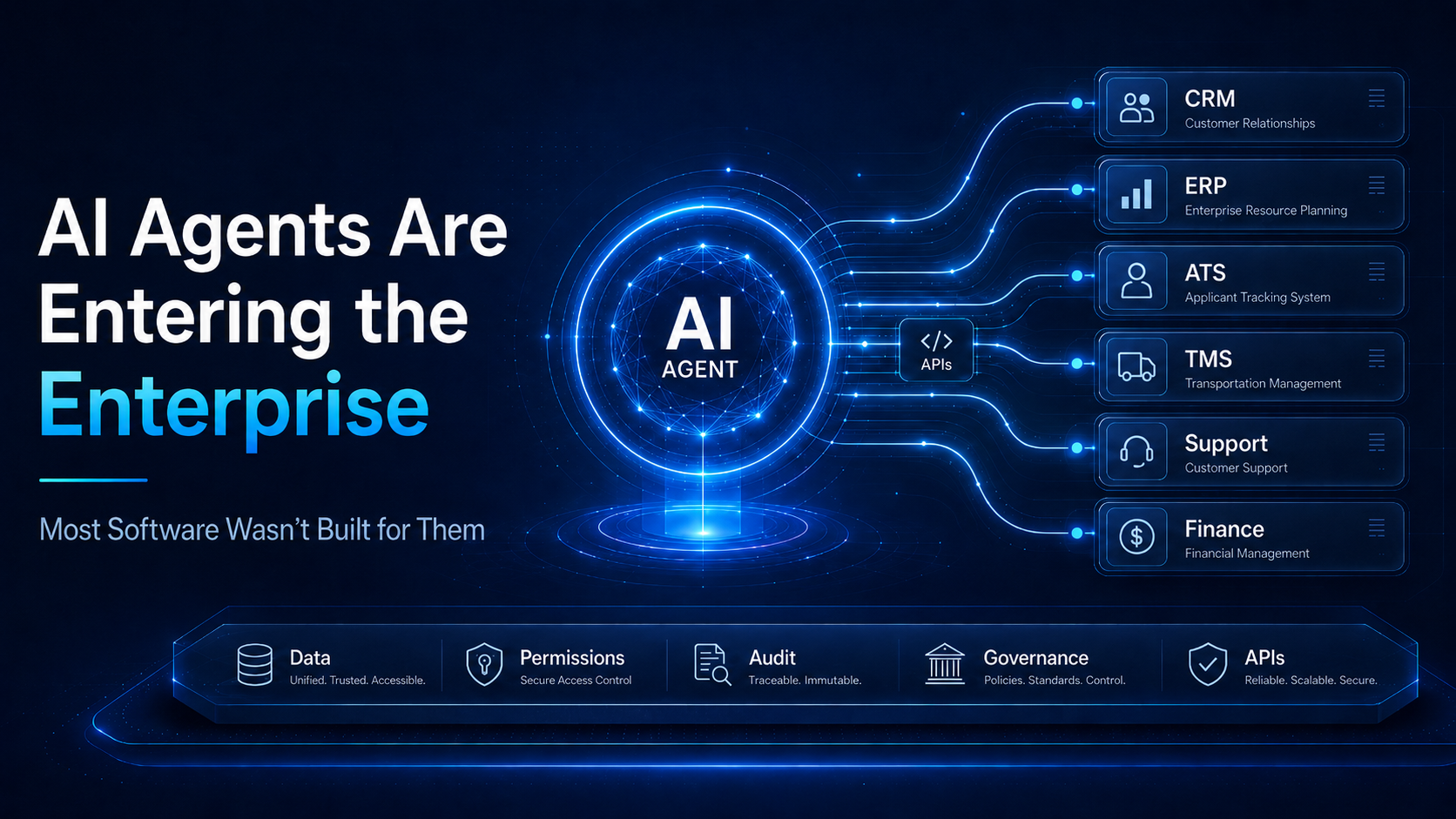
The real bottleneck is not the model. It is the architecture, data, access control, and governance around it.
Enterprise software was built around a simple assumption: the user is human.
A person logs in, reads a screen, clicks through a workflow, makes a decision, and leaves a trace.
AI agents break that assumption.
They do not use software the way employees do. They call APIs, pull data from several systems, write back to records, trigger workflows, and sometimes move faster than any team can review manually.
That is why the next wave of enterprise AI will not be decided only by model quality. It will be decided by whether the software around the model can handle a new kind of user: non-human, persistent, API-driven, and capable of acting across business systems.
The shift is already visible. Gartner predicts that up to 40% of enterprise applications will include task-specific AI agents by 2026, up from less than 5% in 2025. At the same time, Gartner also warns that over 40% of agentic AI projects may be canceled by the end of 2027, mainly because of rising costs, unclear business value, and inadequate risk controls.
That tension is the point.
AI agents are moving into enterprise software. But many enterprise systems are still not ready to let them work safely, reliably, or at scale.
A new kind of enterprise user just showed up
For decades, enterprise software design started with a familiar mental model: a person in front of a screen.
A logistics coordinator checks shipment statuses. A recruiter reviews applications. A claims processor works through a queue. A finance specialist validates invoices. The UI, permissions, workflows, and audit trails were all designed around that human rhythm.
An AI agent has a different operating pattern.
It does not patiently navigate a dashboard. Instead, it requests data, calls tools, compares records, drafts decisions, updates fields, and escalates exceptions. The same workflow may touch CRM, ERP, ATS, TMS, support, finance, and document systems at once.
That can create real value. It can also expose every weak point in the architecture.
A missing API becomes a blocker. Outdated documentation becomes a production risk. Inconsistent data becomes automated inconsistency. A broad admin token becomes a security problem. A vague approval process becomes an agent making decisions it should never make alone.
The agent is not just another UI feature. It is a new class of enterprise user. Most systems were not designed with that user in mind.
Why production breaks after the demo works
Most enterprise AI demos look clean because the environment is clean. The data is prepared. The workflow is narrow. The edge cases are hidden. The agent has one clear task and a small number of tools.
Production is different.
The agent needs data from three systems. One has a modern API. One has an API but the documentation no longer matches the real behavior. The third has no API at all, only a weekly Excel export that someone still runs manually.
For a human team, that friction is painful but survivable. People ask around, remember workarounds, check old Slack threads, and use judgment that was never written into the process.
An agent does not have that institutional memory unless the system gives it a reliable way to access, interpret, and act on the right information.
This is where the API gap matters. Postman’s 2025 State of the API report found that 89% of developers use AI, but only 24% design APIs with AI agents in mind. The same report notes that 51% of developers now cite unauthorized agent access as a top security risk.
Data readiness is another weak point. Informatica’s 2025 CDO Insights Report found that data quality, completeness, and readiness remain one of the top barriers to generative AI success.
This is the uncomfortable part: AI agents do not remove technical debt. They expose it faster.
A messy data model gives the agent messy context. Overly broad permissions turn it into a security risk. Vague workflows make it unclear when to act, when to wait, and when to ask a human.
That is not a model problem. It is an architecture problem.
What “agent-ready” actually means
Agent-ready software is not software with a chatbot attached to it.
It is software that can be used by an AI agent safely, predictably, and with enough control for production work.
At minimum, that means five things.
First, a stable API layer. Agents need machine-readable contracts, versioned endpoints, clear schemas, predictable error states, and documentation that reflects how the system behaves today. An API that works only because an internal developer knows the hidden rules is not agent-ready.
Second, structured and reachable data. The agent must be able to access the right data in the right format, not scrape it from screens, parse inconsistent exports, or guess which field is current.
Third, scoped non-human identities. An agent should not operate through a shared admin account or a reused employee token. It needs its own identity, its own permissions, and clear limits: what it can read, what it can suggest, what it can draft, and what it can execute.
Fourth, auditability. The system should not only record that a field changed. It should show which agent acted, what input it used, which tool or API was called, whether a rule was applied, and whether a human approved the final action.
Fifth, human approval for high-risk decisions. Payments, pricing changes, medical necessity decisions, hiring recommendations, contract changes, and customer-facing messages should not move from suggestion to execution without a defined approval path.
Security teams are already formalizing these risks. The OWASP Top 10 for Agentic Applications 2026 highlights risks such as agent behavior hijacking, tool misuse, identity and privilege abuse, cascading failures, and misplaced human-agent trust.
That is why governance cannot be added at the end. It has to be part of the system design.
Where the readiness gap hurts most
Some industries feel this gap more sharply because the workflows are complex, regulated, and full of fragmented systems.
In logistics, the value of agents is obvious: monitor shipments, flag SLA risks, compare documents, check route exceptions, and escalate problems before they become expensive. But logistics data often sits across ERP, TMS, WMS, carrier portals, scanned documents, spreadsheets, and email threads. An agent can only help if those systems expose reliable data and clear action boundaries.
In healthcare, the technical problem becomes a compliance problem very quickly. Prior authorization, claims review, and clinical documentation are real candidates for AI-assisted workflows, but protected health information, audit requirements, and medical decision oversight make “just automate it” a dangerous approach. The regulatory direction is also clear: the American Medical Association’s 2025 state legislative update notes a sharp rise in state-level AI healthcare bills, and states including Arizona, Maryland, Nebraska, and Texas moved to restrict or oversee AI use in health insurance decisions.
Retail looks simpler on the surface. Agents can monitor inventory, supplier terms, promotions, and pricing signals. The hard part is not detecting a pricing issue. The hard part is deciding whether the agent may change the price, who approves it, what happens if the source data is wrong, and how the business explains that decision later.
In HRTech, the issue is explainability and compliance. Agents can help screen profiles, draft candidate summaries, and support recruiters. But hiring workflows are already regulated. New York City requires employers using automated employment decision tools to complete bias audits and provide required notices. In Europe, GDPR Article 22 gives people rights related to decisions based solely on automated processing when those decisions produce legal or similarly significant effects.
Across these industries, the pattern is the same. The agent is not the hard part by itself. The hard part is connecting the agent to real systems without losing control.
Why “just add AI” fails
Many AI initiatives start with the same assumption: the current system stays as it is, and an AI layer makes it faster.
That works in a demo. It rarely works cleanly in production.
An agent will not fix a chaotic process. It will run that process faster. Inconsistent data still leads to inconsistent decisions, and brittle integrations turn every workflow into a chain of possible failures. Without clear approval rules, the agent may stop too often or continue when it should not.
The market is still early. McKinsey’s 2025 State of AI survey found that 23% of respondents are scaling agentic AI somewhere in their organizations, while another 39% are still experimenting.
That is an important distinction. Experimenting with agents is not the same as running them safely across core business workflows.
The companies that move from pilot to production usually do more than pick a better model. They clean up the data layer, define API contracts, and separate agent permissions from human permissions. Approval logic becomes part of the workflow. Monitoring and rollback paths are built before the agent touches production. Most importantly, the team decides where autonomy is useful and where it is reckless.
That work is not glamorous. It is also the work that determines whether AI becomes operational leverage or another expensive pilot.
Before you deploy an AI agent, ask these questions
The first question is not “Which AI vendor should we choose?”
The first question is whether the system is ready for an agent to use it.
Where does the critical data live? Can it be accessed programmatically, or does the process still depend on exports, screenshots, manual checks, and undocumented workarounds?
Are the APIs documented, versioned, and tested against automated usage patterns? Do they return clear errors? Can they handle higher-volume machine activity without breaking normal operations?
Does the agent have its own identity and scoped permissions, or is it borrowing access from a human user?
Which actions can the agent take alone? What should remain a suggestion? Where is human approval required every time?
Can the system explain what the agent did, what data it used, which tool it called, and who approved the final step?
Have the workflows been tested against edge cases that human employees currently solve through experience, judgment, and context that never made it into the software?
These are not theoretical AI strategy questions. They are software engineering questions. AI agents simply make them harder to postpone.
The engineering underneath the intelligence
The visible part of enterprise AI gets most of the attention: the chat interface, the assistant, the demo that answers in plain language.
That layer matters. But it is not where most production failures start.
The agent that actually improves operations has to work with the systems underneath: CRM, ERP, ATS, TMS, support tools, document repositories, finance systems, and internal workflows. It has to read the right data, call the right API, respect permissions, leave an audit trail, and know when the next step belongs to a human.
That foundation rarely appears in vendor demos. It is also the foundation that determines whether AI creates value or stays stuck in pilot mode.
Allmatics works at this layer: integration architecture, data structure, software modernization, secure workflows, and technical consulting for products that need to become ready for AI-driven operations.
The question is no longer whether AI agents will enter enterprise software. They already are.
The real question is whether your systems are ready to let them work without turning speed into risk.
FAQ
What does “agent-ready” enterprise software mean?
It means the system can be used by an AI agent safely and predictably. That requires stable APIs, structured data, scoped non-human permissions, audit logs, and approval workflows for high-risk actions.
Why do AI agent projects fail in production?
Many fail because the surrounding environment is not ready: fragmented data, brittle integrations, outdated documentation, unclear permissions, weak monitoring, and no defined escalation path for decisions that need human review.
Can we add AI agents on top of existing enterprise software?
Sometimes, but not safely by default. If the existing system has messy data, manual workarounds, undocumented APIs, or vague approval flows, the agent will inherit those weaknesses and may amplify them.
Which industries are most affected by the AI agent readiness gap?
Logistics, healthcare, retail, and HRTech are especially exposed because they combine complex workflows, fragmented systems, regulated decisions, and high operational consequences.
How should a company prepare for AI agents?
Start with a readiness audit: map critical data, check API maturity, define agent permissions, separate autonomous and approval-based actions, and make sure every agent action can be traced and reviewed.