
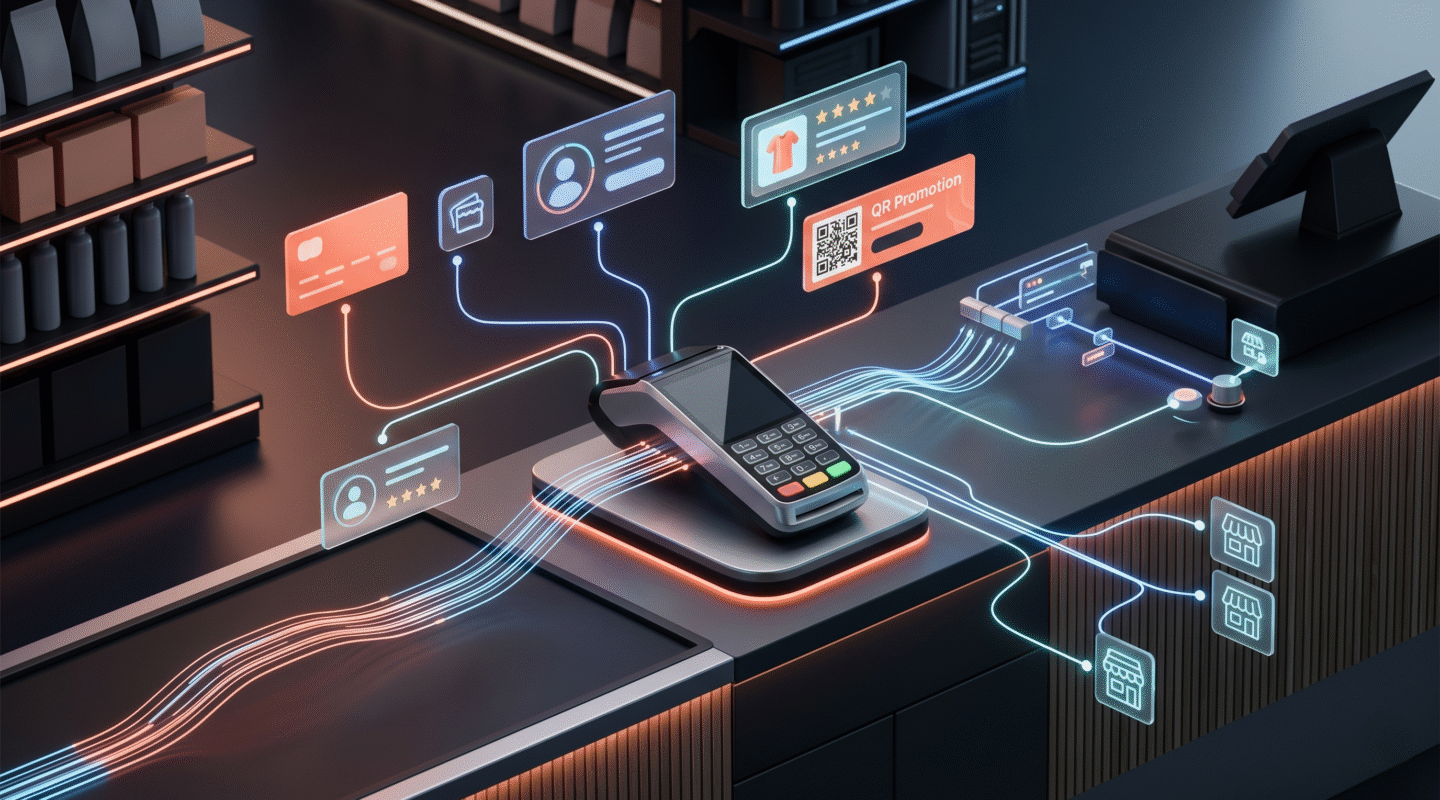
In retail, customer data is everywhere and still underused.
Point-of-sale systems capture purchases. Stores collect consent. Loyalty programs track visits. Reviews appear across public platforms. Yet in many SME retail environments, those signals stay fragmented. The business sees activity, but it cannot act on it fast enough or consistently enough to turn that activity into retention.
That gap sat at the center of one of our retail projects: the development of a POS-connected customer engagement platform for a US retail startup. The product was built for small and mid-sized retailers with dealer and partner networks and combined loyalty tools, review automation, personalized campaigns, and real-time engagement linked to point-of-sale activity.
The timing matters. In 2026, retail is placing much more value on platforms that unify customer, transaction, and operational data. The market is moving toward connected commerce models where point-of-sale is no longer just a checkout layer. It is part of the customer data foundation.
Retail in 2026 is rewarding connected systems, not isolated features
That shift is visible across several 2026 industry signals.
The OECD notes that digitalisation is reshaping retail SMEs, accelerating multi-channel models such as click-and-collect and changing how smaller retailers compete. At the same time, the NRF highlighted in its 2026 retail outlook that AI-driven personalization, richer customer data usage, and more integrated retail operations are becoming mainstream priorities.
Large commerce platforms are sending the same message. Shopify’s 2026 view of retail transformation describes unified commerce as a single, real-time operating model connecting POS, online storefronts, inventory, orders, and customer profiles. In practice, that means retailers increasingly need one system of record for engagement, not a stack of disconnected tools.
Even current market moves reflect this direction. In April 2026, Reuters reported that Tesco partnered with Adobe to strengthen AI-driven personalized marketing using loyalty and customer data at scale. The signal is clear: retailers are investing where customer data, personalization, and execution meet.
This is exactly why this case matters beyond the delivery story itself. It was not just a build for campaign management. It was infrastructure for acting on retail data in real time.
The business problem was not a lack of marketing ideas
The client did not come to us with a mature product. It came with a clear business hypothesis: retailers were losing customer engagement opportunities because transaction data was not connected to timely, usable marketing actions.
That distinction matters.
The challenge was not to invent another loyalty feature set or bolt on another messaging tool. The challenge was to create a platform architecture that could transform routine store activity into triggered, personalized engagement without requiring enterprise-level implementation effort.
For SMEs, that constraint is decisive. Smaller retail operators rarely have internal teams that can manage custom integrations, high-maintenance workflows, or complex deployment models. If the product is difficult to configure, the business does not scale. If the engagement logic is detached from POS reality, the campaigns lose relevance.
What Allmatics built
As we covered in the original case study, the resulting product was a marketing management SaaS platform for SMEs with networks of dealers and partners. It focused on real-time, individualized engagement at the point of sale and combined several operational layers inside one product.
1. Retention and loyalty tools
The platform included smart targeted pages, coupons, referral mechanics, loyalty campaigns, reminder settings, gift card flows, and promotion management. These were not isolated campaign assets. They were operational components designed to support repeat visits, reactivation, and store-level engagement.
2. Reputation and review workflows
The product also supported requests for customer reviews, survey and validation flows, and social media connections. This made sense in a retail context where reputation often influences conversion before the next purchase even begins. BrightLocal’s latest Local Consumer Review Survey shows that reviews still play a meaningful role in local business discovery and decision-making, especially for businesses competing on trust and convenience rather than only on price.
3. POS-connected marketing execution
The strongest part of the product was the connection between point-of-sale activity and customer engagement. The platform supported customizable templates, QR-based flyer printing, birthday campaigns, scheduling logic, and payment-linked customer flows. In other words, the POS was not treated as a passive record of what happened. It became a trigger for what should happen next.
That is a much stronger product position in 2026 than a standard loyalty dashboard. Retailers increasingly want systems that can turn first-party signals into timely execution across channels, not just store data in one place.
Why the architecture mattered
A retail SaaS platform for SMEs has to solve a more difficult product challenge than it seems at first glance.
Enterprise platforms can rely on implementation teams, longer onboarding cycles, and dedicated admin resources. SME-facing products usually cannot. They need to be configurable by operators who are running stores, managing staff, and handling day-to-day customer activity at the same time.
For this project, we built the platform with .NET, AngularJS, Google Cloud, and Kubernetes. Those choices supported a multi-tenant setup capable of handling customer growth, partner structures, and flexible branding without turning every new client into a separate engineering project.
That architectural discipline fits the broader 2026 market direction. As Shopify notes in its article on customer data integration and unified commerce, fragmented data makes it harder to maintain consistency across channels, while a more unified data model helps businesses scale customer experience and operations more effectively.
This is also where security and procurement readiness enter the picture. From the early stages of the project, we also accounted for SOC 2-aligned security expectations, which is especially relevant for platforms handling customer data, communication permissions, and behavioral signals. In parallel, the OECD’s 2026 work on SMEs in the age of AI underscores that digital adoption now has to be accompanied by stronger security readiness, not only by feature growth.
The delivery model was as important as the feature set
One of the most important parts of this project was the delivery sequence.
We followed a phased path from proof of concept to MVP, launch, and scaling, with the first 16 months covering the core build-up of the platform and the broader product journey continuing beyond that. That matters because it shows where the technical risk was handled: early.
The proof-of-concept stage validated the integration approach. The MVP focused on the core loyalty and review flows. The launch phase added broader product capability and network readiness. Scaling then expanded the platform’s ability to support growth.
That is a practical product lesson for retail SaaS teams. In connected commerce products, integration logic should be tested before surface-level expansion. It is much cheaper to validate the movement of data, the rules of engagement, and the tenant model early than to retrofit them after go-live.
Why this kind of platform became more valuable in 2026
Retail technology buyers in 2026 are looking more carefully at what sits underneath the interface.
NRF’s 2026 industry view points to stronger attention on personalization, customer signals, and adaptable retail infrastructure. Capgemini’s consumer trends report for 2026 adds another layer: shoppers are becoming more selective, more value-conscious, and more sensitive to trust, clarity, and relevance in brand interactions.
That changes what creates platform value.
A retailer does not benefit much from generic engagement tools if they cannot reflect live store behavior. A fragmented stack can still send messages, but it struggles to send the right message at the right moment, with the right context. A connected platform has a stronger chance of doing that consistently.
This is where the case becomes strategically interesting for retail software teams. The product combined first-party transaction signals, operator-friendly workflows, and scalable multi-tenant architecture in one retail-specific system. In a market that increasingly rewards unified commerce and practical personalization, those are durable product strengths.
Three lessons for teams building retail SaaS now
Own the operational layer, not just the customer-facing feature
A coupon, loyalty program, or review request flow can be copied. A clean operational layer that connects POS events, permissions, customer actions, and campaign logic is much harder to replace. That is where long-term product value tends to accumulate.
Build for store operators, not ideal users
If a product assumes enterprise implementation capacity, it will break in SME retail. The more flexible the platform looks in a pitch deck, the more carefully its day-to-day usability has to be designed.
Treat data structure as part of product strategy
In retail software, data architecture is not back-office plumbing. It directly affects campaign timing, targeting quality, reporting clarity, partner scalability, and future integration options. In 2026, that is no longer a technical footnote. It is part of the commercial case.
Final thought
The most valuable part of this retail case was not simply the original product idea. It was the ability to turn that idea into a product architecture suited to the way retail is actually changing.
SME retailers do not need more disconnected tools. They need systems that help them act on real customer behavior without adding operational drag. That is what this platform was built to do.
As 2026 retail continues moving toward unified commerce, stronger first-party data use, and more accountable personalization, products built on connected transaction logic are likely to matter more than products built around isolated features.
If you are building retail software and evaluating what makes a platform scalable, defensible, and commercially relevant, this is one of the first layers worth getting right.